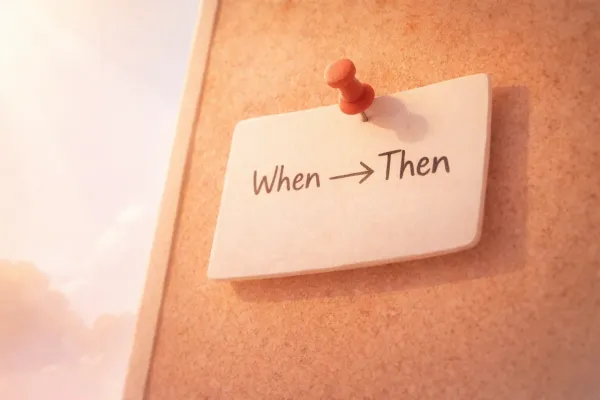
The If-Then Plan
People who write "When X happens, I will do Y" are two to three times more likely to follow through. The trick isn't motivation. It's pre-deciding.

People who write "When X happens, I will do Y" are two to three times more likely to follow through. The trick isn't motivation. It's pre-deciding.

Customers who complain and get a great recovery become more loyal than customers who never had a problem. The same mechanism works inside organizations.

22% of turnover happens in the first 45 days. It's not an onboarding content problem. It's a belonging signal problem. New hires are scanning every interaction for one thing: do I fit here?

Teams that seek consensus don't get better decisions. They get faster convergence and suppressed information. Disagreement isn't a bug. It's a feature.

In restaurants, the "family meal" isn't about food. It's a brief daily ritual that synchronizes the team and surfaces problems before they escalate. Any team can steal it.

Every person added to a meeting beyond seven reduces decision quality by roughly 10%. Not because of introversion. Because of math.

Companies spend $380 billion annually on training. Only 10-30% transfers to the job. The issue isn't learning. It's that old environments trigger old habits.

When teams underperform, the instinct is to diagnose problems. But deficit analysis triggers blame. A faster path: find your bright spots and replicate them.

Zajonc's research revealed something counterintuitive: we don't like things because we know them. We like them because we've seen them. Remote workers lose influence not from worse work, but from less visibility.

Companies spend billions on perks that don't move engagement, retention, or performance. The research points to three things employees actually want, and none of them are free snacks.

Most exit interviews ask "why are you leaving?" The better question: "what almost made you leave before?" It surfaces fixable problems instead of post-hoc rationalizations.

Robert Cialdini placed a simple sign in hotel rooms: "75% of guests in this room reused their towels." Reuse rates jumped 26%. The sign cost nothing. The mechanism is social proof.